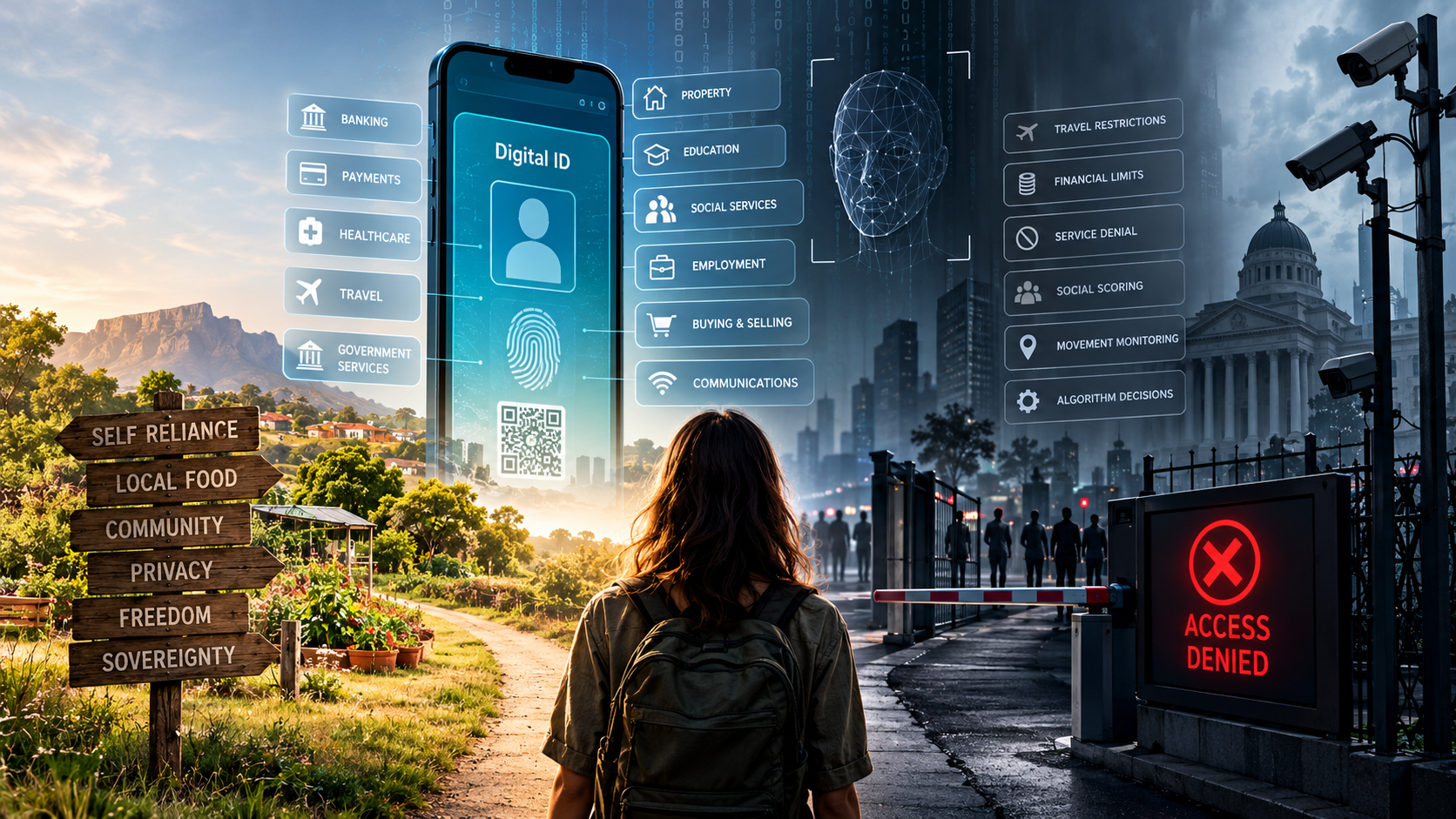
There is a conversation we need to have about Digital ID.
Not because technology is inherently bad.
Not because every government is inherently evil.
And not because we should fear everything new.
We need to have it because something much bigger than an electronic version of an identity document is being built around us — and most people have very little understanding of what that infrastructure could eventually mean.
Before we ask whether Digital ID is convenient, we should understand what it connects — and what becomes possible once identity becomes infrastructure.
What exactly is South Africa's Digital ID?
South Africa is developing a Digital Identity system as part of a broader programme of digital government transformation.
Under the current proposal, Digital ID will allow citizens to store, access and use secure digital versions of Home Affairs documents — including identity documents, birth certificates and marriage certificates — on a smartphone. It also introduces remote identity confirmation using biometric verification.
As of October 2026, government says use of Digital ID will be voluntary and that physical Smart ID cards will continue to exist alongside it.
Read only that description and it sounds wonderfully convenient.
Less paperwork.
Remote verification.
Faster access to services.
Less identity fraud.
Those are real potential benefits.
But Digital ID is not being developed in isolation.
Digital ID is only one part of the architecture
South Africa's MyMzansi roadmap describes a broader form of infrastructure known as Digital Public Infrastructure, or DPI.
Its four major initiatives are Digital Identity, Data Exchange, Digital Payments and Trusted Digital Channels. The programme also includes digital consent management, security logging, audit trails and common API standards.
Who are you?
What is known?
How does value move?
Which services connect?
Now we are no longer talking simply about replacing a plastic card with something on a phone.
We are talking about infrastructure.
And infrastructure changes how societies function.
How does the wider system work?
Think about your life today.
SARS holds tax information.
Banks hold financial information.
Property systems record ownership.
Government departments hold different administrative records.
Healthcare, education and employers may each hold other pieces of your life.
Historically, many of these systems have existed separately.
The MyMzansi roadmap proposes a government data exchange capable of real-time access between departments and entities. Its milestones include a Master Social Security Registry, extending data exchange to at least 20 additional databases, and later opening selected access to non-government entities for specified experimentation and agency models.
The roadmap also includes a digital financial identity initiative and plans for increasingly integrated government payment infrastructure.
Again, there are legitimate reasons for this. Information may no longer need to be submitted repeatedly. Eligibility can be checked faster. Fraud may be reduced. Government services can become easier to use.
But this is where the question changes.
What happens when identification, information, payments and access become increasingly interoperable?
Identity is not the same thing as permission
An identity system answers:
An interconnected system can potentially answer something else:
Those are fundamentally different functions.
South Africa's own roadmap already includes using administrative datasets for eligibility testing of grants. In that context, there is an obvious administrative purpose.
But the architecture matters beyond any single use case.
WHO ARE YOU?
↓
WHAT DOES THE SYSTEM KNOW?
↓
WHAT ARE YOU ELIGIBLE OR PERMITTED TO ACCESS?
This does not establish that South Africa intends to use Digital ID to control people's movement or ordinary purchases.
It does establish why citizens should understand the difference between a system that merely verifies identity and infrastructure capable of linking identity to decisions about eligibility and access.
Why capability matters
The usual reassurance is to ask why today's government would misuse the system.
But that is not the most important systems-design question.
The question is not only: “Do I trust the people building this?” It is: “What prevents anyone controlling it in the future from using it differently?”
Governments change. Laws change. Corporations change ownership. Emergencies happen. Definitions change. Technology created for one purpose can acquire additional purposes later.
Good architecture therefore cannot depend only upon permanently good intentions.
It needs limits.
We already know conditional access is technically possible
China is often described online as having one giant social-credit score controlling every citizen. That description oversimplifies a much more fragmented system.
But some forms of digitally coordinated restriction are documented.
China's Supreme People's Court operates a national blacklist for people who refuse to comply with enforceable court judgments. The Court says it has worked with financial institutions and transport authorities to restrict listed defaulters from activities including purchasing airline and high-speed rail tickets and luxury goods.
The important lesson is not that South Africa is China.
It is that information held in one institutional context can technically be used to affect participation somewhere else.
When identity becomes connected to access, a record can become a restriction.
This is part of a worldwide digital transformation
Digital Public Infrastructure is not uniquely South African. The World Bank says its Global DPI Program supports more than 80 countries in building or scaling systems including digital identity, payments and secure data sharing.
The United Nations Development Programme likewise works on interoperable digital infrastructure and explicitly recognises both its benefits and its risks. UNDP notes that data exchanges are already being deployed in areas affecting people's lives, including social-protection eligibility, lending, healthcare and education, and warns that weak safeguards can amplify privacy and discrimination risks.
So asking difficult questions about Digital ID is not anti-technology.
It is precisely what a technologically mature society should do.
But there is a deeper problem
Digital ID sits inside a much larger pattern that concerns me.
We increasingly respond to unhealthy human behaviour by constructing another layer of control around everybody.
Crime increases.
We add security.
Security fails.
We add cameras.
Fraud increases.
We add biometric verification.
Identity theft increases.
We collect more identity information.
And slowly the abnormal becomes normal.
Living behind electric fences becomes normal.
Being filmed everywhere becomes normal.
Having our bags searched becomes normal.
Proving who we are repeatedly becomes normal.
Being monitored “for our own safety” becomes normal.
Each response may solve a real immediate problem.
But what if the accumulation of solutions creates another problem entirely?
What kind of society are we creating that requires this much surveillance, verification, security and control simply to function?
Security treats the consequence. Consciousness asks about the cause.
Technology can help prevent fraud.
It cannot teach integrity.
Surveillance can sometimes deter crime.
It cannot create conscience.
A stronger lock can stop someone entering my home.
It cannot answer why another human being believes they have the right to take what belongs to me.
A sophisticated identity system may make impersonation harder.
It cannot answer why identity theft became so common that entire populations must continually prove they are not criminals.
Perhaps one of our greatest mistakes is believing every human problem requires another external control.
Responsibility?
Community?
Purpose?
Healthy families?
Accountability?
Conscience?
Human beings who understand that freedom carries responsibility toward other human beings?
We invest extraordinary resources in systems designed to control behaviour.
How much do we invest in developing human beings who require less control?
Convenience has a long memory
Every generation inherits technologies chosen by the generation before it.
It also inherits their consequences.
A system introduced because it saves twenty minutes today may become infrastructure a future generation cannot function without.
That does not automatically make the technology wrong.
It makes the questions more important.
What information does the system actually need?
Who can access it?
Which datasets can be connected?
Can identity become linked to the ability to transact?
Can access to an essential service ever be suspended?
What happens when the information is wrong?
Can someone appeal while still being able to live normally?
Can a person still participate without the digital credential?
Will that alternative remain genuinely usable in ten or twenty years?
What powers are we creating that future generations may find difficult to undo?
Privacy is not suspicious behaviour
“If you have nothing to hide, why should you care?”
Because privacy is not evidence of wrongdoing.
Privacy is a boundary around being human.
My relationships are not automatically somebody else's business.
My purchases do not automatically require a behavioural profile.
My movements do not automatically require observation.
My identity should not automatically become the key connecting every part of my existence.
A human being should not have to justify wanting parts of life to remain private.
Perhaps the real conversation is sovereignty
This is not an argument to abandon technology.
Technology can liberate people, democratise knowledge and solve extraordinary problems.
But there is a difference between using technology and becoming dependent upon technology for permission to participate in ordinary life.
That distinction deserves considerably more attention.
Can I participate in a digital society without a single interconnected system becoming my only pathway to money, food, movement, communication, work and essential services?
Perhaps that is the conversation we need to begin now.
Not after the infrastructure is complete.
Not after alternatives have quietly disappeared.
Not after convenience has become dependency.
Before.
Because a mature society does not only ask what technology can do for us.
It also asks what powers the technology creates — and whether those powers should exist at all without meaningful limits.
See the whole picture.
The Inside Code explores the patterns beneath people, organisations and systems — especially what becomes visible when we stop treating each consequence in isolation.
Sources and context
- South African Government: Draft Digital Identity regulations and voluntary use
- South African Government: Digital ID to coexist with the physical Smart ID
- MyMzansi: Digital Transformation Roadmap
- MyMzansi: Data Exchange
- MyMzansi: Digital Payments
- World Bank: Global Digital Public Infrastructure Program
- UNDP: Data governance and safeguards for Digital Public Infrastructure
- Supreme People's Court of China: Enforcement blacklist and restrictions
This article distinguishes the capabilities created by interconnected digital infrastructure from predictions about how South Africa will use those capabilities in future. The South African Digital ID proposal is currently voluntary; the wider questions concern architecture, dependency, safeguards and how rules may evolve over time.